Deep-learning models designed to identify both direct and indirect imaging findings on CT have shown diagnostic performance comparable to or better than experienced physicians for pancreatic cancer detection, researchers have found.
The models' performance is particularly striking when it comes to small tumors, wrote a team led by Takeru Yamaguchi, MD, of Kobe University Graduate School of Medicine in Japan. The results were published June 16 in Radiology.
"The high sensitivity of these models supports their potential role in improving detection, particularly for small and early-stage pancreatic cancer," the group noted.
Pancreatic cancer carries a five-year survival rate of only 13%, largely because most patients are diagnosed at advanced stages. But patients whose tumors are detected at 10 mm or smaller and who undergo surgery to remove them have reported ten-year survival rates exceeding 90%. A tool that reliably flags subtle indirect CT findings -- including duct abnormalities in patients undergoing routine imaging for unrelated conditions -- could shift diagnoses earlier along that survival curve, Yamaguchi and colleagues wrote.
That's why the researchers explored the use of deep-learning to help detect pancreatic cancer. They conducted a study that included data from between August 2007 and December 2022 from 2,251 patients who had undergone either contrast-enhanced or noncontrast-enhanced CT imaging. They then developed two deep-learning models, one for each exam type, designing them to identify not only pancreatic masses but also indirect signs of malignancy such as parenchymal atrophy, main pancreatic duct dilatation, and main pancreatic duct stenosis -- all findings that frequently precede or accompany tumors that are too small to be directly visualized, they explained. Six readers of varying CT interpretation experience read the exams.
Overall, the group reported the following:
- For pancreatic cancer diagnosis on contrast-enhanced CT, the model achieved an area under the receiver (AUC) operating characteristic curve of 0.99, matching the reader mean.
- On noncontrast CT, the models outperformed the reader mean with an AUC of 0.93 versus 0.91. This performance advantage was most prominent for tumors 20 mm or smaller, and the team found that sensitivity reached 98% on contrast-enhanced CT compared with 82.6% for the reader mean, and 86% versus 41.1% on noncontrast CT.
- For pancreatic cancer diagnosis, the deep-learning models performed comparably or better than the mean of six readers in both the contrast-enhanced CT set (AUC, 0.99 versus 0.99; p = 0.84) and the noncontrast-enhanced set (AUC, 0.93 versus 0.91; p = 0.03).
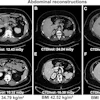
Yet perhaps one of the most important findings is that the deep-learning models reduced image analysis time, to roughly 20 to 22 seconds per patient compared with a reader mean of 63 to 78 seconds. Representative images in patients with pancreatic cancer (PC) diagnosed by the deep learning (DL) models. Original axial images (left), corresponding segmentation-masked images (middle), and DL model outputs (right) are shown. The segmented areas of the pancreatic parenchyma, main pancreatic duct (MPD), and pancreatic masses are indicated by yellow, teal, and red overlay, respectively. (A) Contrast-enhanced CT (CECT) images in an 84-year-old man with worsening diabetes mellitus show a 10-mm mass in the pancreatic body with upstream MPD stenosis and dilatation and parenchymal atrophy. The tumor was pathologically confirmed as PC (T1b). (B) CECT images in an 83-year-old man undergoing postoperative surveillance for gastric gastrointestinal stromal tumor show MPD stenosis and dilatation with parenchymal atrophy without a visible mass. The tumor was pathologically confirmed as PC (tumor in situ). (C) Noncontrast CT (NCCT) images in a 65-year-old man undergoing follow-up for mantle cell lymphoma show a 32-mm mass in the pancreatic head with MPD stenosis and dilatation. The tumor was pathologically confirmed as PC (T2). (D) NCCT images in an 81-year-old woman with abdominal distension show MPD stenosis and dilatation with parenchymal atrophy without a visible mass. The tumor was pathologically confirmed as PC (T1b).RSNA
Since the models showed higher sensitivity but lower specificity than readers, the team suggested that their most valuable role may be as second-reader tools that alert radiologists -- particularly less experienced ones interpreting noncontrast studies in screening or surveillance settings -- to findings that might otherwise be missed.
"Prospective multicenter studies involving diverse populations and various pancreatic diseases are needed to evaluate the clinical utility and generalizability of the models," Yamaguchi and colleagues concluded. "Future studies are warranted to clarify the clinical impact of artificial intelligence assistance for pancreatic cancer detection."
Read the whole study here.