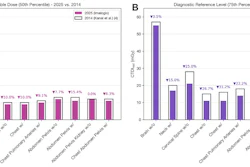
The American College of Radiology (ACR) has highlighted the benefits of CT in response to an April 14 study suggesting that the scans are linked to new cases of cancer.
“The theoretical radiation risk proposed by Smith-Bindman, et al, is consistent with prior statistical modeling studies that are not based on actual patient outcomes… There are no published studies directly linking CT scans (even multiple CT scans) to cancer,” the ACR stated.
Medical imaging exams – including CT – are a primary factor in declining cancer death rates, and are directly linked to decreased hospital mortality rates and greater life expectancy, ACR said.
The organization urged patients to ask their physician or other medical provider the following questions:
- How will having this exam improve my healthcare?
- Are there alternatives that do not use radiation which are equally as good (e.g. MRI, ultrasound, etc.)?
- Is this facility ACR Accredited (which ensures high quality standards, including regular surveys of the equipment by medical physicists, certified technologists performing the exams, and interpretation by radiologist physicians who meet stringent education and training standards)?
Among its efforts to reduce inappropriate and unnecessary imaging and radiation exposure, the ACR noted it co-founded the Image Gently and Image Wisely initiatives.

![Images show the pectoralis muscles of a healthy male individual who never smoked (age, 66 years; height, 178 cm; body mass index [BMI, calculated as weight in kilograms divided by height in meters squared], 28.4; number of cigarette pack-years, 0; forced expiratory volume in 1 second [FEV1], 97.6% predicted; FEV1: forced vital capacity [FVC] ratio, 0.71; pectoralis muscle area [PMA], 59.4 cm2; pectoralis muscle volume [PMV], 764 cm3) and a male individual with a smoking history and chronic obstructive pulmonary disorder (COPD) (age, 66 years; height, 178 cm; BMI, 27.5; number of cigarette pack-years, 43.2, FEV1, 48% predicted; FEV1:FVC, 0.56; PMA, 35 cm2; PMV, 480.8 cm3) from the Canadian Cohort Obstructive Lung Disease (i.e., CanCOLD) study. The CT image is shown in the axial plane. The PMV is automatically extracted using the developed deep learning model and overlayed onto the lungs for visual clarity.](https://img.auntminnie.com/mindful/smg/workspaces/default/uploads/2026/03/genkin.25LqljVF0y.jpg?auto=format%2Ccompress&crop=focalpoint&fit=crop&h=100&q=70&w=100)


![Images show the pectoralis muscles of a healthy male individual who never smoked (age, 66 years; height, 178 cm; body mass index [BMI, calculated as weight in kilograms divided by height in meters squared], 28.4; number of cigarette pack-years, 0; forced expiratory volume in 1 second [FEV1], 97.6% predicted; FEV1: forced vital capacity [FVC] ratio, 0.71; pectoralis muscle area [PMA], 59.4 cm2; pectoralis muscle volume [PMV], 764 cm3) and a male individual with a smoking history and chronic obstructive pulmonary disorder (COPD) (age, 66 years; height, 178 cm; BMI, 27.5; number of cigarette pack-years, 43.2, FEV1, 48% predicted; FEV1:FVC, 0.56; PMA, 35 cm2; PMV, 480.8 cm3) from the Canadian Cohort Obstructive Lung Disease (i.e., CanCOLD) study. The CT image is shown in the axial plane. The PMV is automatically extracted using the developed deep learning model and overlayed onto the lungs for visual clarity.](https://img.auntminnie.com/mindful/smg/workspaces/default/uploads/2026/03/genkin.25LqljVF0y.jpg?auto=format%2Ccompress&crop=focalpoint&fit=crop&h=112&q=70&w=112)