The U.S. Preventive Services Task Force (USPSTF) is inviting comment as it develops a draft recommendation for assessing cardiovascular disease (CVD) via coronary artery calcium (CAC) scoring or the ankle-brachial index.
The task force is considering the following questions:
- What is the effectiveness or comparative effectiveness of enhanced cardiovascular disease risk assessment with coronary artery calcium scoring or the ankle-brachial index on cardiovascular health outcomes?
- What is the effectiveness or comparative effectiveness of enhanced cardiovascular disease risk assessment with coronary artery calcium scoring or the ankle-brachial index on physiologic outcomes or patient and provider decision-making outcomes?
- Does the use of coronary artery calcium scoring or the ankle-brachial index to predict cardiovascular disease risk improve measures of calibration, discrimination, and risk reclassification compared with the use of multivariate cardiovascular disease risk assessment without these risk markers?
- What are the harms of using coronary artery calcium scoring or the ankle-brachial index for enhanced cardiovascular disease risk assessment?
- Does treatment guided by coronary artery calcium scoring or the ankle-brachial index lead to improved health outcomes?
- What are the harms of treatment guided by coronary artery calcium scoring or the ankle-brachial index?
The task force last evaluated the assessment of cardiovascular disease in 2018. It is taking comment on this current draft until May 22.



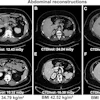
![Axial images from unenhanced calcium score cardiac CT (left) and curved planar reformation images from CT angiography (right) show that higher long-term exposure to air pollution is associated with greater coronary artery calcium and more obstructive coronary artery disease (CAD). Top row: Images in a 68-year-old male patient with higher 10-year mean ambient air pollution exposure (7.9 μg/m3 for particulate matter measuring ≤2.5 μm in diameter [PM2.5] and 17.4 parts per billion [ppb] for NO2) with extensive CAD (coronary artery calcium score [CACS] >1,000 and obstructive CAD [≥70% diameter stenosis]). Bottom row: Images in a 57-year-old female patient with lower 10-year mean ambient air pollution exposure (6.3 μg/m3 for PM2.5 and 4.6 ppb for NO2) with no CAD (CACS = 0 and no obstructive stenosis).](https://img.auntminnie.com/mindful/smg/workspaces/default/uploads/2026/06/hanneman.r6SMLzkezo.png?auto=format%2Ccompress&fit=crop&h=100&q=70&w=100)


![Axial images from unenhanced calcium score cardiac CT (left) and curved planar reformation images from CT angiography (right) show that higher long-term exposure to air pollution is associated with greater coronary artery calcium and more obstructive coronary artery disease (CAD). Top row: Images in a 68-year-old male patient with higher 10-year mean ambient air pollution exposure (7.9 μg/m3 for particulate matter measuring ≤2.5 μm in diameter [PM2.5] and 17.4 parts per billion [ppb] for NO2) with extensive CAD (coronary artery calcium score [CACS] >1,000 and obstructive CAD [≥70% diameter stenosis]). Bottom row: Images in a 57-year-old female patient with lower 10-year mean ambient air pollution exposure (6.3 μg/m3 for PM2.5 and 4.6 ppb for NO2) with no CAD (CACS = 0 and no obstructive stenosis).](https://img.auntminnie.com/mindful/smg/workspaces/default/uploads/2026/06/hanneman.r6SMLzkezo.png?auto=format%2Ccompress&fit=crop&h=112&q=70&w=112)