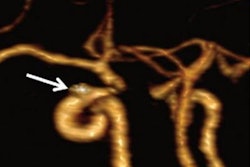
CT cerebral angiography makes emergency department (ED) diagnosis of headache more effective, researchers have found.
A team led by Dustin Mark, MD, of Kaiser Permanente Medical Center in Oakland, CA, reported that use of the technique was associated with “fewer lumbar punctures and higher detection of unruptured intracranial aneurysms, with no significant change in missed diagnoses of subarachnoid hemorrhage or bacterial meningitis.” The results were published April 19 in JAMA Network Open.
The investigators conducted a study that included data from 198,109 encounters at 21 emergency departments that involved the use of CT cerebral angiography between 2015 and 2021.
They found that use of the technique increased “six-fold relative to lumbar puncture, with a 33% increase in the detection of unruptured intracranial aneurysms and no significant change in missed diagnoses of subarachnoid hemorrhage or bacterial meningitis.”
“[Our] findings suggest emergency physicians are increasingly using computed tomography cerebral angiography and less often using lumbar puncture for headache evaluations, which appears safe in the short-term but has uncertain long-term consequences,” the group concluded.
The full study can be found here.