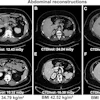
Patients undergoing multiple CT exams are receiving unacceptably high collective radiation doses, according to a study published July 22 in the European Journal of Radiology.
A team led by Dr. Narjes Moghadam of the Sherbrooke University Hospital Research Center (CRCHUS) in Québec, Canada, estimated the percentage of patients undergoing multiple CT exams that led to cumulative effective radiation doses of more than 25 mSv, 50 mSv, 75 mSv, and 100 mSv in one year. The group's study included data from 43,010 patients who underwent 75,252 CT examinations in one year.
Of these patients, 21.3% were younger than 50 and 12.3% younger than 40. The team found the following:
- 0.67% of patients received a cumulative effective radiation dose of more than100 mSv.
- 3.5% received a cumulative effective radiation dose of more than 50 mSv.
- 1.9 % received a cumulative effective radiation dose of more than 25 mSv.
- The maximum cumulative effective radiation dose was 529 mSv.
- Minimum time to reach 100 mSv was a single exam; seven patients received that radiation dose in a single CT exam.
- 0.36% of patients had 10 or more CT exams in one year; 3.8% had five or more CT exams in one year.
The investigators found that the mean cumulative effective radiation dose was 12.3 mSv.
"The alarming high cumulative effective dose received by a large number of patients and with high collective dose to population requires urgent actions by all stakeholders in the best interest of patient radiation safety," the group concluded.