Canon Medical Systems USA is launching a new scanner designed to perform the full range of cardiovascular CT studies -- but with a footprint that fits in a cardiologist's office -- at this week's Society of Cardiovascular Computed Tomography (SCCT) meeting.
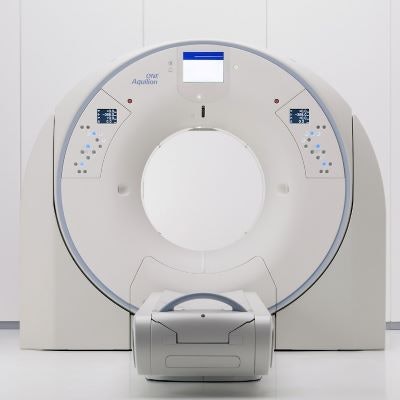
Called Aquilion One / Genesis SP, the scanner is designed to perform whole-heart cardiac CT scans in a single heartbeat with 16 cm of coverage. The scanner also includes Canon's image processing and optimization tools, like Advanced intelligent Clear-IQ Engine (AiCE) deep-learning reconstruction protocol and SURECardio and Vitrea advanced visualization tools.
 Canon's Aquilion One / Genesis SP CT scanner. Image courtesy of Canon Medical Systems USA.
With Genesis SP, Canon specifically addressed the economic issues behind cardiac CT that the company believes have held back more rapid adoption of the modality for heart imaging. The system features an air-cooled rather than water-cooled design, which reduces total cost of ownership and enables the system to be sited in a smaller area -- 204 sq. ft., or about the amount of room that a cardiac SPECT system might take up in a cardiologist's office.
Genesis SP also includes features designed to help with scanner operation during the COVID-19 era. For example, the scanner has an automated patient protocol that can position the patient in the system's isocenter automatically, without requiring intervention by the radiologic technologist, It also includes scanner disinfection protocols that Canon announced earlier this year in partnership with Surfacide. The protocols can reduce disinfection times from one hour to five to 10 minutes, according to the company.
Genesis SP sports a 78-cm bore and a patient couch that's 47 cm wide and lowers to 33 cm off the floor.