Sunday, November 29 | 11:45 a.m.-11:55 a.m. | SSA06-07 | Room E353A
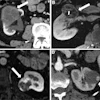
Tumor volume often falls significantly after chemotherapy, but the drop in iodine uptake may be more significant for prognosis. A group from Johns Hopkins University measured treatment response using iodine uptake with dual-energy CT (DECT) before and after treatment of pancreatic cancer.The study was performed to evaluate quantitative changes in iodine uptake by pancreatic adenocarcinoma before and after chemotherapy using dual-source, dual-energy CT, lead author Dr. Satomi Kawamoto wrote in an email to AuntMinnie.com.
Patients with newly diagnosed pancreatic cancer were scanned, and tumor volume decreased in 86% of the patients after treatment. Average tumor iodine uptake fell in the arterial phase and also in the venous phase.
"Iodine uptake by pancreatic adenocarcinoma by dual-energy CT may be potentially useful for assessment of treatment response," Kawamoto wrote.