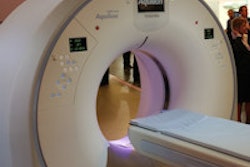
Toshiba Medical Systems plans to use this week's ECR 2015 meeting to launch Aquilion Lightning, a new 16-detector-row CT scanner.
Lightning is equipped with a small element detector size of 0.5 mm for routine isotropic imaging, and is packaged in an environmentally and ergonomically friendly design, Toshiba said. The scanner incorporates the latest generation of Toshiba's fast iterative reconstruction technology (AIDR 3D Enhanced) as well as Toshiba's new PureVision detector to minimize radiation exposure.
Also included are advanced clinical applications including single-energy metal artifact reduction (SEMAR) to eliminate metal artifacts and improve visualization of implants, supporting bone and adjacent soft tissue, Toshiba said.
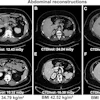
In addition, the firm's SureSubtraction technology improves visualization of vessels and contrast-enhanced tissue structures, Toshiba said, while the company's Navi mode technology offers simplified scanner operation and guides novices through every step of the operation.
Lightning sports a 78-cm gantry opening to accommodate even the largest patients, Toshiba added. And the couch-top can be lowered to a minimum height of 312 mm from the floor, to facilitate transfers of patients from a wheelchair or gurney. Finally, a footprint of just 9.8 m2 allows the scanner to be placed in the smallest exam rooms to enhance the working environment, Toshiba said.
Lightning will originally be sold only in Europe, with the first installation going into Germany in early March.