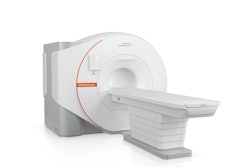
Siemens Healthineers announced U.S. Food and Drug Administration (FDA) clearance of its Magnetom Free.XL interventional MRI system at RSNA 2026. Attendees at its South Hall booth also got a first look at an agentic AI assistant for managing imaging equipment fleets.
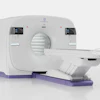
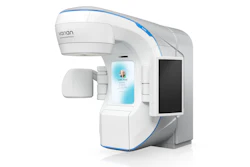
Interventional MRI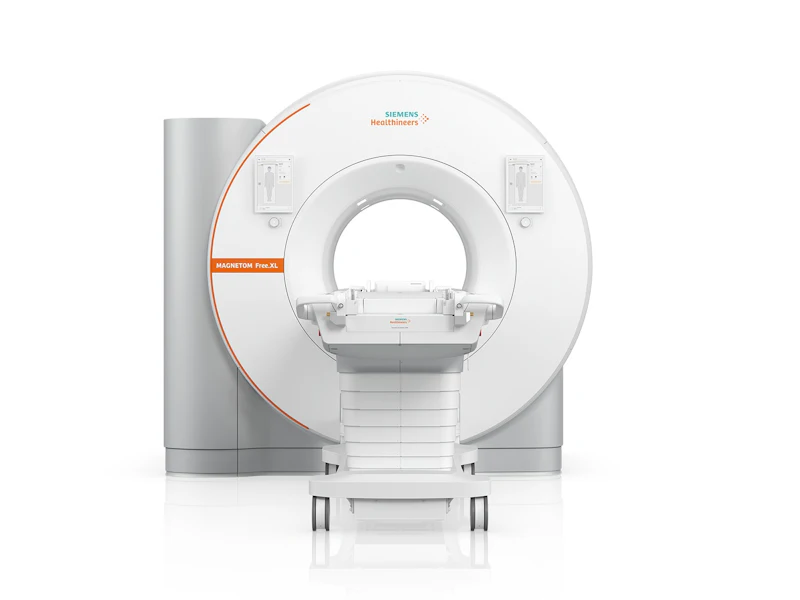 The Magnetom Free.XL interventional MRI system.Siemens Healthineers
The Magnetom Free.XL clearance comes a year after Siemens Healthineers showcased the system as a work-in-progress at RSNA 2025. The 0.55-tesla scanner is designed to provide real-time guidance without ionizing radiation for procedures such as vascular access and soft-tissue biopsies. The company describes it as its first MRI system built specifically for interventional radiology.
The field strength improves needle visibility, reduces metal artifacts, and lowers the specific absorption rate (SAR) for MR-guided procedures, according to the firm. The system has a 100-cm flared bore and an elevated system height for physician access. Its DryCool zero-refill helium design requires no quench pipe. Siemens Healthineers said this allows the scanner to be sited in interventional suites, operating areas, or next to intensive care units.
Other features include the following:
myNeedle Companion software for 3D needle trajectory planning, skin entry point localization, and real-time navigation.
XL gradients and Deep Resolve AI-based image reconstruction.
A dedicated interventional coil and BioMatrix contour coils.
The Nexaris Dockable Table for moving patients between interventional, intraoperative, and diagnostic settings.
Free.XL can also perform diagnostic imaging at 0.55T. It is the foundation of the interventional MRI (iMRI) Suite that Siemens Healthineers is developing with Cook Medical. The suite pairs the scanner with Cook's MRI-compatible devices, along with suite planning, training, and clinical support.
Agentic AI
The company's new teamplay AI Assistant was developed with Microsoft. It lets technologists, operations managers, and radiology department heads query equipment performance data in natural language. The assistant is built on an agentic AI architecture using Microsoft Azure and Microsoft Foundry. It returns explanations, reports, and visualizations, and recommends actions ranked by their potential effect on the organization. For example, it can flag when scheduling patterns leave scanners idle and suggest adjustments to use the available capacity, according to the company.
Beta testers included University Hospital Geneva, the company noted. The assistant is integrated into teamplay Performance Management and is available through Siemens Healthineers' teamplay platform.
Check out AuntMinnie’s full coverage of RSNA 2026 on our conference page.