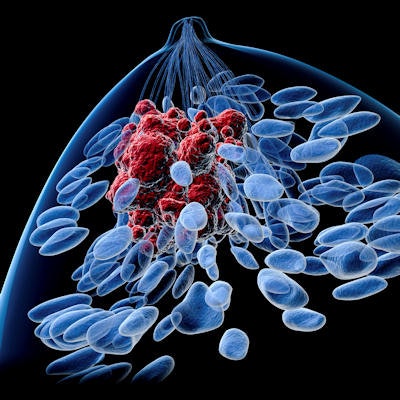
The University of Arizona Department of Medical Imaging has been awarded $3.6 million to develop a new CT-based method to detect and diagnose breast cancer.
A grant from the U.S. National Cancer Institute bestows the funds on the university over five years to advance the efforts of Andrew Karellas, PhD; Srinivasan Vedantham, PhD; and the department's Biomedical Imaging Innovation and Clinical Translation in Next-Gen CT (BIG-CT) team to develop a new breast-specific CT exam that will provide 3D images of breast tissue.
The research will aim to reduce patient discomfort with breast cancer screening and also provide an accurate assessment of breast density, according to the university.








![Images show the pectoralis muscles of a healthy male individual who never smoked (age, 66 years; height, 178 cm; body mass index [BMI, calculated as weight in kilograms divided by height in meters squared], 28.4; number of cigarette pack-years, 0; forced expiratory volume in 1 second [FEV1], 97.6% predicted; FEV1: forced vital capacity [FVC] ratio, 0.71; pectoralis muscle area [PMA], 59.4 cm2; pectoralis muscle volume [PMV], 764 cm3) and a male individual with a smoking history and chronic obstructive pulmonary disorder (COPD) (age, 66 years; height, 178 cm; BMI, 27.5; number of cigarette pack-years, 43.2, FEV1, 48% predicted; FEV1:FVC, 0.56; PMA, 35 cm2; PMV, 480.8 cm3) from the Canadian Cohort Obstructive Lung Disease (i.e., CanCOLD) study. The CT image is shown in the axial plane. The PMV is automatically extracted using the developed deep learning model and overlayed onto the lungs for visual clarity.](https://img.auntminnie.com/mindful/smg/workspaces/default/uploads/2026/03/genkin.25LqljVF0y.jpg?auto=format%2Ccompress&crop=focalpoint&fit=crop&h=112&q=70&w=112)


