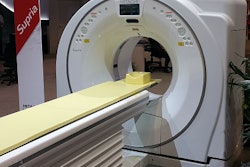
Advanced visualization software developer Vital Images has introduced new software aimed at helping providers manage CT lung screening programs and hired healthcare industry veteran Paul Markham, PhD, as vice president of marketing.
Vital's Lung Screening Program helps to standardize diagnosis of lung nodules and presentation of treatment plans, according to the firm. Its custom reporting template uses the American College of Radiology (ACR)-approved Lung Imaging Reporting and Data System (Lung-RADS) and ensures that key findings are communicated to clinicians for follow-up and treatment planning, Vital said.
Vital is also pointing to the package's image denoising software, which removes pixel noise from the image via an adaptive algorithm that smoothes uniform tissue while preserving edges of the image, according to the company. On-site training and online education resources are also included for technologists and physicians. In addition, Vital said it can provide comprehensive software for managing patients participating in lung screening programs.
Meanwhile, Markham comes to Vital Images with more than 25 years of healthcare technology experience, most recently serving as chief strategy and marketing officer for Origenetics. He has also had stints at GE Healthcare and TeraMedica. In his new role, Markham will be responsible for leading Vital's marketing team and aligning the firm's corporate marketing initiatives with its parent company, Toshiba.



![Images show the pectoralis muscles of a healthy male individual who never smoked (age, 66 years; height, 178 cm; body mass index [BMI, calculated as weight in kilograms divided by height in meters squared], 28.4; number of cigarette pack-years, 0; forced expiratory volume in 1 second [FEV1], 97.6% predicted; FEV1: forced vital capacity [FVC] ratio, 0.71; pectoralis muscle area [PMA], 59.4 cm2; pectoralis muscle volume [PMV], 764 cm3) and a male individual with a smoking history and chronic obstructive pulmonary disorder (COPD) (age, 66 years; height, 178 cm; BMI, 27.5; number of cigarette pack-years, 43.2, FEV1, 48% predicted; FEV1:FVC, 0.56; PMA, 35 cm2; PMV, 480.8 cm3) from the Canadian Cohort Obstructive Lung Disease (i.e., CanCOLD) study. The CT image is shown in the axial plane. The PMV is automatically extracted using the developed deep learning model and overlayed onto the lungs for visual clarity.](https://img.auntminnie.com/mindful/smg/workspaces/default/uploads/2026/03/genkin.25LqljVF0y.jpg?auto=format%2Ccompress&crop=focalpoint&fit=crop&h=100&q=70&w=100)


![Images show the pectoralis muscles of a healthy male individual who never smoked (age, 66 years; height, 178 cm; body mass index [BMI, calculated as weight in kilograms divided by height in meters squared], 28.4; number of cigarette pack-years, 0; forced expiratory volume in 1 second [FEV1], 97.6% predicted; FEV1: forced vital capacity [FVC] ratio, 0.71; pectoralis muscle area [PMA], 59.4 cm2; pectoralis muscle volume [PMV], 764 cm3) and a male individual with a smoking history and chronic obstructive pulmonary disorder (COPD) (age, 66 years; height, 178 cm; BMI, 27.5; number of cigarette pack-years, 43.2, FEV1, 48% predicted; FEV1:FVC, 0.56; PMA, 35 cm2; PMV, 480.8 cm3) from the Canadian Cohort Obstructive Lung Disease (i.e., CanCOLD) study. The CT image is shown in the axial plane. The PMV is automatically extracted using the developed deep learning model and overlayed onto the lungs for visual clarity.](https://img.auntminnie.com/mindful/smg/workspaces/default/uploads/2026/03/genkin.25LqljVF0y.jpg?auto=format%2Ccompress&crop=focalpoint&fit=crop&h=112&q=70&w=112)