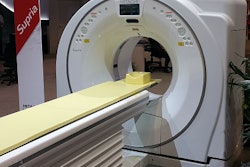
Hitachi Medical Systems America has announced U.S. Food and Drug Administration (FDA) clearance to market two new CT scanners within its Scenaria platform: Scenaria SE 64 and Scenaria SE 128.
The Scenaria SE scanners feature added capabilities for faster workflow and better ease of use, and they are compliant with the Smart Dose (XR-29) radiation dose reporting standard, Hitachi said.
Scenaria SE also has 40% faster standard reconstruction speed, up to 50 images per second, as well as faster reconstruction for multiplanar reformats (MPRs), with added automation of frequently used operator functions. The scanners also have an upgraded standard patient table weight capacity, up to 550 lb, for bariatric patient accommodation.





![Axial images from unenhanced calcium score cardiac CT (left) and curved planar reformation images from CT angiography (right) show that higher long-term exposure to air pollution is associated with greater coronary artery calcium and more obstructive coronary artery disease (CAD). Top row: Images in a 68-year-old male patient with higher 10-year mean ambient air pollution exposure (7.9 μg/m3 for particulate matter measuring ≤2.5 μm in diameter [PM2.5] and 17.4 parts per billion [ppb] for NO2) with extensive CAD (coronary artery calcium score [CACS] >1,000 and obstructive CAD [≥70% diameter stenosis]). Bottom row: Images in a 57-year-old female patient with lower 10-year mean ambient air pollution exposure (6.3 μg/m3 for PM2.5 and 4.6 ppb for NO2) with no CAD (CACS = 0 and no obstructive stenosis).](https://img.auntminnie.com/mindful/smg/workspaces/default/uploads/2026/06/hanneman.r6SMLzkezo.png?auto=format%2Ccompress&fit=crop&h=112&q=70&w=112)


