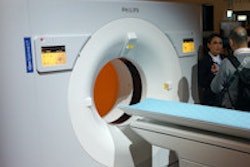
Philips Healthcare has issued a class 2 device recall for more than 400 of its CT scanners due to a software defect, according to the U.S. Food and Drug Administration (FDA).
In a notice dated April 1, the FDA said that a letter Philips sent to customers in February 2015 indicated that the defect was related to an inversion of the sign indication of the longitudinal position on some types of scans. Customers should refrain from using images derived from multiplanar reconstructions for identifying the absolute position of an intervention for feet-first patient orientation.
The recall affects some 424 scanners in the Brilliance CT 64-channel with Essence technology, Brilliance iCT, Brilliance iCT SP, Ingenuity Core, Ingenuity Core128, and Ingenuity CT product lines. Philips field service engineers will be contacting customers to arrange installation of software designed to fix the problem.






![Images show the pectoralis muscles of a healthy male individual who never smoked (age, 66 years; height, 178 cm; body mass index [BMI, calculated as weight in kilograms divided by height in meters squared], 28.4; number of cigarette pack-years, 0; forced expiratory volume in 1 second [FEV1], 97.6% predicted; FEV1: forced vital capacity [FVC] ratio, 0.71; pectoralis muscle area [PMA], 59.4 cm2; pectoralis muscle volume [PMV], 764 cm3) and a male individual with a smoking history and chronic obstructive pulmonary disorder (COPD) (age, 66 years; height, 178 cm; BMI, 27.5; number of cigarette pack-years, 43.2, FEV1, 48% predicted; FEV1:FVC, 0.56; PMA, 35 cm2; PMV, 480.8 cm3) from the Canadian Cohort Obstructive Lung Disease (i.e., CanCOLD) study. The CT image is shown in the axial plane. The PMV is automatically extracted using the developed deep learning model and overlayed onto the lungs for visual clarity.](https://img.auntminnie.com/mindful/smg/workspaces/default/uploads/2026/03/genkin.25LqljVF0y.jpg?auto=format%2Ccompress&crop=focalpoint&fit=crop&h=112&q=70&w=112)


