Email Printer Friendly
Road to RSNA 2011: Molecular Imaging Preview
By Wayne Forrest, AuntMinnie.com staff writer
November 8, 2011

At this year's annual RSNA meeting, the advance of hybrid imaging and the development of new imaging agents are expected to be among the most intriguing developments in molecular imaging and nuclear medicine in Chicago.

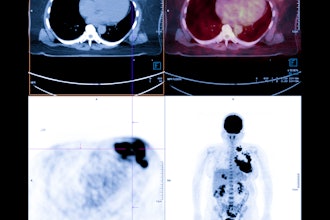
PET/MRI, which took RSNA 2010 by storm a year ago, will continue to show its potential in a number of clinical applications, including the detection of hypermetabolic lesions. Dr. Alexander Drzezga, from Technische Universität München, is scheduled to detail results of the first clinical comparison between simultaneous whole-body PET/MRI and PET/CT to characterize lesions in patients with oncological diagnoses (Wednesday, November 30, 10:40 a.m.-10:50 a.m., SSK13-02, Room S505AB).

One other significant trend in molecular imaging is an increasing number of multimodality and multitracer imaging studies. Dutch researchers will show promising early results for two novel molecular imaging techniques to detect and manage lymph node metastases in prostate cancer patients. The group from Radboud University Nijmegen is evaluating ferumoxtran-10-enhanced MRI (MR lymphography) and carbon-11 choline PET/CT to assess the number, size, and location of lymph node metastases (Monday, November 28, 11:20 a.m.-11:30 a.m., SSC09-06, Room S504CD).

Road to RSNA 2011: Molecular Imaging Preview On Thursday, Dr. Umar Mahmood, PhD, associate director of the division of nuclear medicine and molecular imaging at Massachusetts General Hospital, will be the keynote speaker for a series of scientific paper presentations on molecular imaging probes that are applicable for MRI, ultrasound, and PET/MRI (Thursday, December 1, 10:30 a.m.-12:00 p.m., SSQ09, Room S504CD).

At the Lakeside Learning Center, RSNA 2011 will offer daily molecular imaging educational exhibits that include PET imaging of receptors in oncology (LL-MIE1261), nuclear molecular imaging of tumor hypoxia (LL-MIE1264), molecular imaging of apoptosis (LL-MIE2456), and PET tracers beyond FDG for imaging prostate cancer (LL-NME1248).

Other PET and molecular imaging exhibits will feature the new PET Response Criteria in Solid Tumors (PERCIST) lexicon, and there will be a nuclear medicine case of the day (LL-EDE101) at the Lakeside Learning Center.

Among the array of refresher courses is "Brain Imaging Workup for Dementia: FDG-PET, Amyloid PET, and MR Imaging" (Sunday, November 27, 2:00 p.m.-3:30 p.m., RC111, Room E451A). The forum will focus on the roles of PET and MRI in diagnosing dementia and cognitive disorders. The course is designed for physicians and researchers involved in PET imaging of dementia.

Also on Sunday, attendees can learn about the "Essentials of Molecular Imaging and Systems Diagnostics for Clinical Radiologists" (2:00 p.m.-3:30 p.m., RC117, Room E352). The session will cover the definition of molecular imaging, how it is currently practiced, how it differs from conventional diagnostic imaging, and the value of modality fusion. One section will cover the role of molecular imaging in drug development.

An interactive session, titled "Improving PET Interpretation: Present Updates in Head and Neck Cancer and New Horizons with Case Examples," will highlight Tuesday's refresher courses (November 29, 8:30 a.m.-10:00 a.m., RC311, Room S402AB). The use of FDG-PET/CT and fluoro-L-thymidine (FLT) PET to understand the metabolism of normal cells, cancer cells, and cell dynamics will be discussed. Also on the agenda is a discussion of the pros and cons of both modalities for initial staging and treatment response in head and neck cancer.

Below are even more highlights from a multitude of worthwhile molecular imaging and nuclear medicine scientific papers scheduled for presentation at RSNA 2011.

To view the complete RSNA scientific program and abstracts, visit the conference's website.

Scientific and Educational Presentations
Breast imaging benefits from both PET/CT and PET/MRI
Sunday, November 27 | 11:05 a.m.-11:15 a.m. | SSA18-03 | Room S505AB
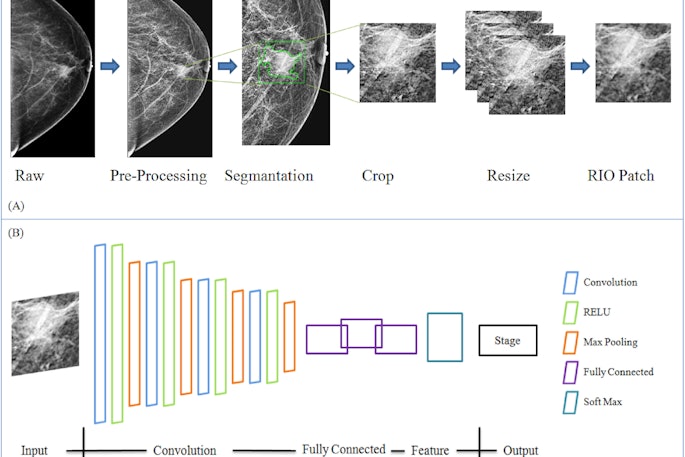
Breast imaging can benefit from contrast-enhanced PET/CT, and even better results can be achieved with PET/MRI, according to a study by researchers from Kochi University Hospital in Japan.
FDG-PET/CT predicts early response to chemo in NSCLC patients
Monday, November 28 | 11:00 a.m.-11:10 a.m. | SSC14-04 | Room S505AB
FDG-PET/CT is showing its prowess in predicting non-small cell lung cancer (NSCLC) tumor metabolic response and length of survival one and five weeks after the start of chemotherapy treatment.
Novel molecular imaging technique could help prostate cancer patients
Monday, November 28 | 11:20 a.m.-11:30 a.m. | SSC09-06 | Room S504CD
In this paper presentation, Dutch researchers will show early promising results for two novel molecular imaging techniques to detect and manage lymph node metastases in prostate cancer patients.
Study questions SUVmax role in solitary pulmonary nodule malignancy
Monday, November 28 | 11:20 a.m.-11:30 a.m. | SSC14-06 | Room S505AB
Researchers at Thomas Jefferson University are challenging the traditional belief that a decrease in glucose metabolism demonstrated by a solitary pulmonary nodule during the delayed phase of dual-point FDG-PET/CT indicates that the nodule is benign.
FDG-PET/CT shows steroid therapy impact on pulmonary nodules
Monday, November 28 | 11:40 a.m.-11:50 a.m. | SSC14-08 | Room S505AB
A pilot study at Children's Hospital of Michigan is seeking to determine whether 40 hours of steroid therapy can help characterize equivocal pulmonary nodules in FDG-PET/CT scans.
Researchers look for link between veterans' motor issues and brain injuries
Monday, November 28 | 3:20 p.m.-3:30 p.m. | SSE19-03 | Room S505AB
With the help of FDG-PET, researchers at the University of Washington are investigating a possible link between Parkinsonian motor symptoms and blast-related mild traumatic brain injury among Iraq and Afghanistan war veterans.
Ga-68 DOTA-NOC tops F-18 DOPA-PET/CT for neuroendocrine tumors
Tuesday, November 29 | 10:50 a.m.-11:00 a.m. | SSG12-03 | Room S505AB
In a comparison with F-18 DOPA-PET/CT, gallium-68 (Ga-68) DOTA-NOC achieved "superior sensitivity" with neuroendocrine tumors, prompting researchers to conclude that Ga-68 DOTA-NOC could help direct more effective patient treatment.
Novel tracer shows early promise for brain tumor imaging
Tuesday, November 29 | 11:40 a.m.-11:50 a.m. | SSG08-08 | Room S504CD
In this scientific paper presentation, researchers from Washington University School of Medicine will present their work on a novel synthesized tracer that so far has shown promising tumor imaging properties in the potential to complement MRI for evaluating patients with primary and metastatic brain tumors.
Choline-PET/CT in recurrent prostate cancer cases could alter therapy
Tuesday, November 29 | 11:50 a.m.-12:00 p.m. | SSG12-09 | Room S505AB
Choline-PET/CT can greatly affect therapy management for recurrent prostate cancer patients and should be considered for restaging, according to a new study by Swiss researchers.
Fused PET/MRI tops MR spectroscopy in brain tumor recurrence
Tuesday, November 29 | 3:00 p.m.-3:10 p.m. | SSJ19-01 | Room S505AB
A study from the University of California, San Diego has found fused FDG-PET/MRI to be more sensitive, specific, and accurate than MR spectroscopy in detecting the recurrence of primary and metastatic brain tumors in patients with a history of grade III or IV brain tumors.
FDG-PET metabolic parameters help differentiate severity of brain tumors
Tuesday, November 29 | 3:20 p.m.-3:30 p.m. | SSJ19-03 | Room S505AB
In this presentation, researchers will discuss how standardized uptake values and glucose metabolic rates can help differentiate between tumors and benign lesions when evaluating patients with central nervous system lesions with FDG-PET.
FDG-PET/CT study helps detect brain changes from chemotherapy
Tuesday, November 29 | 3:50 p.m.-4:00 p.m. | SSJ19-06 | Room S505AB
FDG-PET/CT may be a beneficial diagnostic tool to document cognitive decline, or "chemo brain," in breast cancer patients receiving chemotherapy, according to a study from West Virginia University Hospitals.
MRI protocol developed for attenuation correction in PET/MRI for head and neck cancer
Wednesday, November 30 | 10:50 a.m.-11:00 a.m. | SSK13-03 | Room S505AB
German researchers are developing a potential MRI protocol for use in a PET/MRI system to handle whole-body attenuation correction and diagnostic sequences for staging head and neck cancer patients.

|| About || Advertising || Bookstore || Breast MRI || Career Center || Case of the Day || Communities || Conferences || Contact Us || ECR News 2013 || Education || Equipment Classifieds || Facebook || Forums || Home || Links || Marketplace || Mobile || Molecular Breast Imaging || New Installations || News in Brief || People in the News || Privacy Policy || RSNA News 2012 || Reference || Salary Survey Results || Trends in Radiology || Twitter || Vendor Connect || Webinars || XML/RSS ||

Copyright © 2013 AuntMinnie.com. All Rights Reserved.