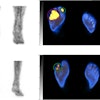


Young woman with toe pain.
|
Which choice most likely characterizes the radiographic finding(s)?
Primary bone neoplasm.Metastatic bone neoplasm.Post-traumatic abnormality.Infection.Congenital anomaly.
|
Findings:
Plain film X-ray: There is a lucent lesion in the terminal phalanx of the great toe. The lesion abuts the articular surface and has a narrow zone of transition without a sclerotic margin. Minimally expansile. No fracture or periosteal reaction identified.
MRI: The examination demonstrates a relatively homogeneous soft tissue mass located within the proximal aspect of the terminal phalanx of the great toe. There are no fluid/fluid levels. The mass is low in signal intensity on T1-weighted images and intermediate to bright on fluid sensitive sequences. It extends to the subarticular surface. There is low level enhancement following contrast administration. The bone appears slightly enlarged in this location, particularly on sagittal images. There is no definite soft tissue extension although the assessment of minor soft tissue extension would be difficult given the small size of the lesion. There is edema in the adjacent marrow space.
Differential diagnosis:
Discussion
Giant cell tumors are the 6th most common primary bone tumor and account for 5% of all primary bone tumors. The classic presentation is a skeletally mature patient, age 20-55 years, who presents with pain, swelling, and limited range of motion at a joint which is alleviated by rest. Up to 30% can present with a pathologic fracture.
Giant cell tumor can be benign or malignant. However, this can only be determined histologically. When giant cell tumors are malignant, the can metastasize to the lungs in 1-2% of cases. Both benign and malignant giant cell tumors tend to recur, often more than once.
Treatment usually consists of curettage. However, curettage alone is associated with a high rate of recurrence. Therefore, cryotherapy or filling the resection cavity with bone graft or methyl methacrylate is commonly performed.
Radiologic overview:
It is not radiographically feasible to determine whether a giant cell tumor is benign or malignant.
Four classic radiographic criteria apply for diagnosing a giant cell tumor in a long bone. If a particular long bone lesion does not meet all four criteria, giant cell tumor can safely be removed from diagnostic consideration.
- The epiphysis must be closed.
- The lesion must be epiphyseal and abut the articular surface.*
- The lesion must be eccentrically located
- The zone of transition must be narrow, but not sclerotic.*
*These rules do not apply to flat bones. They would not apply to giant cell tumors of the pelvis or calcaneus, two common locations.
CT will show soft tissue density with a foci of low attenuation which represents hemorrhage or necrosis. On MRI giant cell tumors tend to show low-intermediate signal intensity on T1 and T2 weighted images. Fluid-fluid levels can be seen. The main role of MRI is to evaluate any extraosseous component.
References: